Is Your Neighborhood Safe? 6 Tools to Help You Find Out

Here are 6 tool to help you research the safety of your Neighborhood
- : Best for checking crime in your state
- : Best for getting a true idea of an area's overall safety
- : Best for connecting with your neighbors
- : Best for finding sex offenders
- : Best for specific crime data
- : Best user-friendly tool
Before you research, consider bias
Safety is subjective. What you consider a safe neighborhood, someone else may not. For example, some may look for a home near a local police station so that help is always minutes away, while others would find that a terrifying neighborhood feature.
While checking out the tools in this article, think about how you use neighborhood safety tools. Are you using them to build or divide your community? When you find problems, look for solutions. Remember that community safety comes from putting in work.
Also, make sure you're not spreading disinformation, and be careful not to racially profile or stereotype people you don't recognize in your neighborhood.

Get updates on the latest safety news, product releases, and deals.
By signing up, you agree to our Terms and Conditions and Privacy Policy.
Keep in mind many of these tools use crime statistics by address and don’t factor in a lot of things that make a neighborhood safe, so the results may be misleading. You don’t get a complete picture of how truly safe a neighborhood is. There are many things that can make a neighborhood safe:
- Good lighting at night
- Sidewalks and biking lanes
- A fire station nearby
- Fire hydrants that are close to homes
- Good schools
- Access to medical care
- Clean parks
And there are plenty of ways to make a neighborhood safer. Here are some neighborhood safety tips.
Neighborhood research tools
These tools have large crime-tracking components, but crime monitoring is just one piece of community safety. We were sure to include safety tools that can help create community-based safety networks too. Whether you're trying to track down a lost pet or solve missing-package mysteries, you have people on your side.

Learn more about community-building in our piece about staying safe in your neighborhood.
1. Best for checking crime in your state: Federal Bureau of Investigation Crime Data Explorer
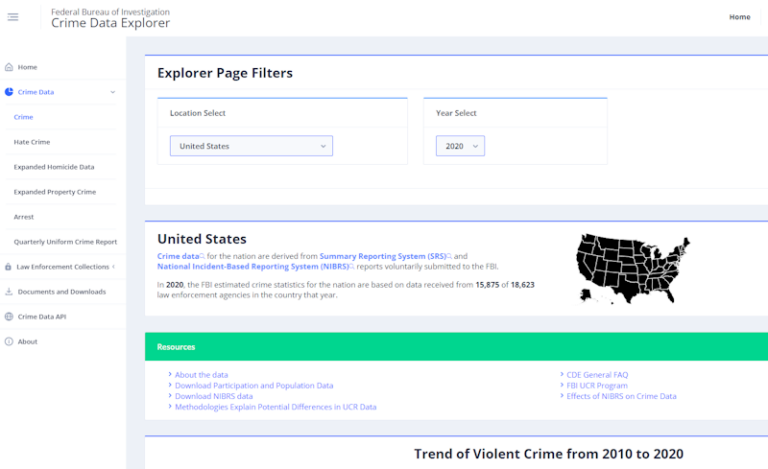
Image: SafeWise
The Federal Bureau of Investigation Crime Data Explorer compiles crime reports from all over the country. While the tool doesn’t portray crime mapping by address, you can find crime data for your state or a state you might want to move to in the future. The data is divided by crime type, including violent crime rate, hate crime, property crime, and arrests.

Is your state on the list? Check out our report The State of Safety in America.
America’s safest cities


Subscribe to our YouTube channel for more videos like this one! Learn how to protect your home, your loved ones, yourself, and your belongings.
2. Best for getting a true idea of an area’s overall safety: AreaVibes
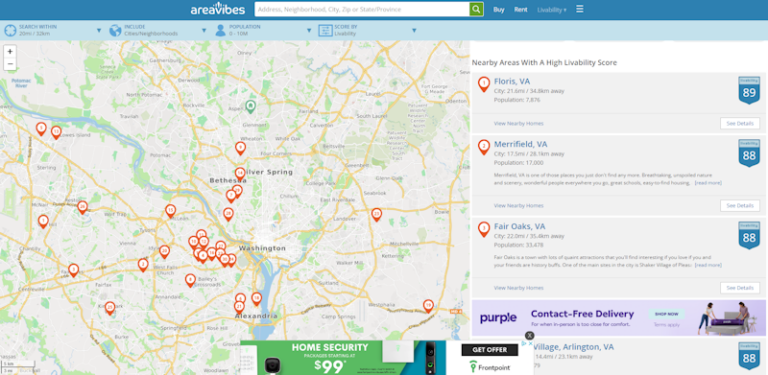
Image: SafeWise
AreaVibes has crime maps, but it also generates neighborhood safety scores based on more than just crime.
AreaVibes assigns a neighborhood safety rating letter grade from F to A+ for each of seven livability factors: crime rate, amenities, cost of living, education, employment, housing, and user ratings. Then, it compares your area’s livability score to state and national averages.
AreaVibes’ custom search function sets it apart from similar tools, allowing you to sort locations by the seven livability factors. This can be helpful if you’re scouting for a new place to live to get a complete picture of just how safe an area is beyond crime statistics.
If crime is most important to you, AreaVibes is a great way to quickly and easily compare the crime activity in several cities. It breaks crimes down by type, number of reported incidents, and crimes per 100,000 people. The site also provides statistics about the area’s crime trends and shows how it compares to state and national crime statistics.
3. Best for contributing and connecting with your neighbors: The Neighbors App
 See who’s at the door Talk to visitors from anywhere Get remote alerts
*Amazon.com list price as of 08/16/2021 at 11:00 a.m. (MT). Read full disclaimer.
The Neighbors App by Ring (known for its doorbell cameras and Ring Alarm home security system) aims to be an online neighborhood watch program. You don’t have to be a Ring customer to use the app. It’s free to download and use no matter what security system or devices you own.
Neighbors uses reports by people in your neighborhood and local law enforcement to alert you to suspicious activities and crime events in your area. You can also anonymously contribute your tips.
Neighbors isn’t just a neighborhood crime app, though. Some neighborhoods use the app to band together and keep safe during natural disasters or organize neighborhood watches. You can also submit or look for information on lost pets.

Educate yourself on your privacy rights and Ring's history with police partnerships before deciding if Neighbors is for you. Ring has its privacy pros and cons to weigh, but it has a reputation for quality products.
4. Best for finding sex offenders: Family Watchdog
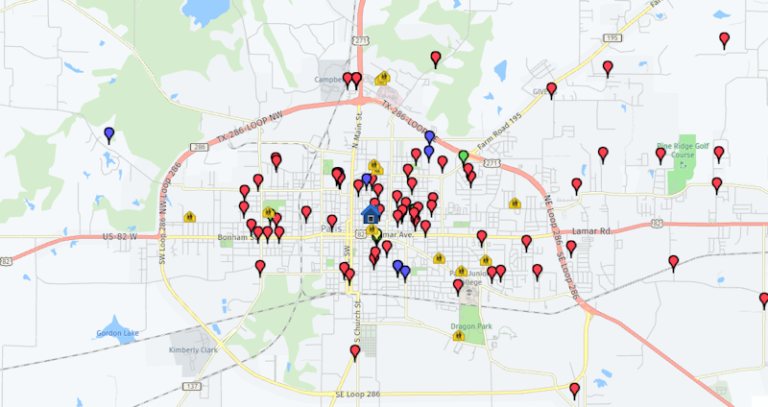
Image: SafeWise
Family Watchdog maps the addresses of registered sex offenders in your neighborhood or near your child’s school. Just type a location or address into the website’s search box, and Family Watchdog generates a map pinpointing the address of nearby registered sex offenders. If you’re looking for a specific individual, you can search for them by name.
Color-coded icons correspond to various sex crimes, including crimes against children, sexual battery, and rape. Click the icon, and you’ll see a picture of the offender, learn their aliases, and find out what sex crime they’ve been convicted of.
You can sign up for alerts whenever a registered sex offender moves in or out of your neighborhood through the website. In addition to detailed information about offenders, this online tool offers personal safety tips, facts about sexual abuse, and a comprehensive blog and newsletter.
Family Watchdog is a free service, but you’ll be sent off-site to a subscription service if you want detailed background reports about any offenders.
5. Best for specific crime data: CityProtect
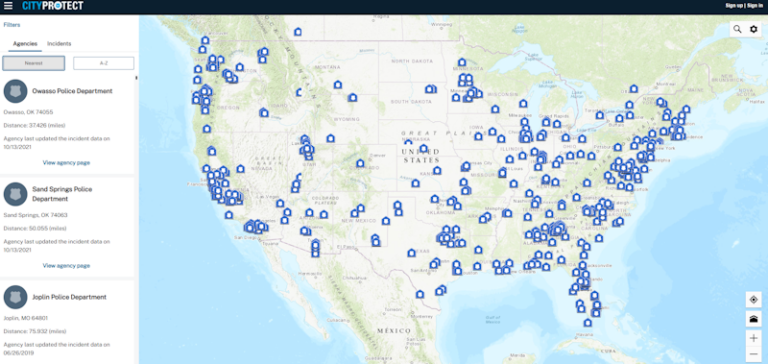
Image: SafeWise
CityProtect is an interactive neighborhood crime map that uses data from more than 1,000 participating law enforcement agencies. Search CityProtect by city, region, address, zip code, or law enforcement agency to see a map with icons identifying recent police activity.
We like how specific this tool gets. Filters allow you to narrow your crime search by date range, day of the week, time of day, and incident type. With CityProtect, you can also sign up for periodic crime alerts, submit a tip, and register your home security camera.
6. Best user-friendly tool: SpotCrime
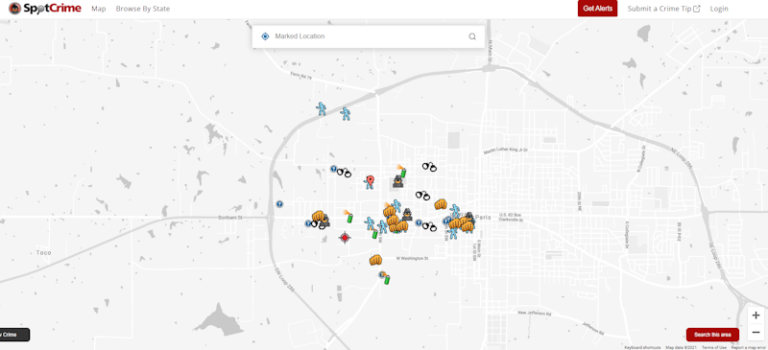
Image: SafeWise
SpotCrime maps crimes on-site and delivers crime alerts to your email. It gathers data from more than just law enforcement agencies. It also collects information from news reports and user tips.
SpotCrime isn’t as robust as some of the other sites on our list, but we appreciate how user-friendly and highly visual it is, giving you a quick look at crime information in your neighborhood. Crimes are represented by icons that make it easy to see what activity takes place in your neighborhood.
When you click on an icon, you get the crime title, when and where it took place, and a link that directs you to the source where the data came from.
How to prevent break-ins
Wherever you live, feeling safe in your home can bring greater peace of mind and happiness. Check out our home security checklist to make sure your home is as protected as possible.
You may also want to consider a monitored home security system or security cameras to help protect your loved ones and valuables. Just seeing a security camera or home security sign or sticker can deter a would-be intruder. And monitored systems can call for law enforcement if a break-in does occur.
If you go this route, there are some things to remember:
- Arming: Make sure your system or camera is armed when you’re away or asleep. Some systems can be armed from an app or put on an arming schedule to make things easier.
- Placement: Place cameras so they get a good view of doorways and windows.
- Sensors: Be sure to install window and door sensors throughout your home, not just at the front door. No matter where the intruder enters, you want the alarm to sound and scare them away.
- Security signs: Place yard signs and window stickers prominently so they will catch the attention of potential intruders.
For more, check out our burglary prevention guide and our guide to outsmarting burglars.
Compare the best home security systems
|
Best for
|
Brand
|
Lowest monitoring price
|
Starter equipment price
|
Contract required
|
Installation
|
Smart home compatibility
 |
Learn more
|
Read review
|
|---|---|---|---|---|---|---|---|---|
| Best overall |
 |
$29.99/mo. | $599.00 |
 No * No * |
Pro | Amazon, Google, Z-Wave |
View Packages | Read review |
| Reader favorite |
 |
$14.99/mo. | $229.00 |
No |
DIY | Amazon, Google | View Packages | Read review |
| Whole-property |
 |
$34.99/mo. | $99.00 |
No |
DIY | Amazon, Google, Z-Wave |
View Packages | Read review |
| Pro monitoring |
 |
$27.99/mo. | $0.00 |
 Yes Yes |
Pro | Amazon, Google, Z-Wave |
View Packages | Read review |
| Customer-focused |
 |
$14.99/mo. | Quote required |
No * |
DIY | Amazon, |
View Packages | Read review |
Info current as of 10/12/2021. Offers and availability may vary by location and are subject to change.
Full ADT disclaimer
Disclaimers
Amazon: *Product prices and availability are accurate as of the date/time indicated and are subject to change. Any price and availability information displayed on Amazon at the time of purchase will apply to the purchase of this product. Safewise.com utilizes paid Amazon links.
Certain content that appears on this site comes from Amazon. This content is provided “as is” and is subject to change or removal at any time.

Recent Articles



The post Is Your Neighborhood Safe? 6 Tools to Help You Find Out appeared first on SafeWise.
Article source here: Is Your Neighborhood Safe? 6 Tools to Help You Find Out
